- Sediroglu Group
- 19 August 2026
Grain Mill
Grain Mill
A grain mill is more than a machine that reduces grain into smaller particles. In industrial production, it represents an integrated processing system designed to receive, clean, prepare, mill, classify and handle grain through a controlled sequence of operations.
Modern grain milling plants may process wheat and other suitable cereals according to the required final product. Depending on the application, a mill can include grain receiving equipment, cleaning machines, conditioning systems, roller mills, sifters, purifiers, conveying lines, storage units and packaging equipment.
The efficiency of a grain mill therefore depends not only on individual machines but also on how effectively these machines work together.
For companies planning a new milling facility or upgrading an existing plant, understanding the complete grain milling process is essential for selecting suitable equipment and developing an efficient production layout.
What Is a Grain Mill?
A grain mill is a processing system used to transform cereal grains into flour, meal or other milled products through a series of mechanical operations.
In small-scale applications, the term may refer to a single grinding machine. In industrial applications, however, a grain mill usually consists of multiple machines arranged according to a defined process flow.
These systems can perform operations such as:
• grain receiving;
• preliminary cleaning;
• fine cleaning;
• separation of impurities;
• grain preparation;
• controlled milling;
• particle classification;
• purification;
• intermediate product handling;
• finished product collection;
• storage and packaging.
The exact equipment configuration varies according to the grain being processed, plant capacity and desired final products.
What Is the Purpose of a Grain Mill?
The main purpose of a grain mill is to process grain into products with defined characteristics.
For flour production, this involves much more than simply crushing kernels. The process must progressively separate, reduce and classify different grain fractions.
An industrial milling system is therefore designed around a controlled process rather than a single grinding operation.
How Does an Industrial Grain Mill Work?
Although every milling plant can have a different configuration, the overall process usually consists of several interconnected stages.
A simplified grain mill process can be represented as:
Grain Receiving → Cleaning → Preparation → Milling → Sifting → Classification → Product Collection → Storage or Packaging
Each stage performs a specific function.
Grain Receiving
The process begins when grain enters the milling facility.
Raw material may arrive from farms, storage facilities, silos or other suppliers. Receiving and conveying equipment directs the grain toward storage or the first processing stage.
At this point, the grain has not yet been prepared for milling.
Grain Cleaning
Raw grain can contain materials that should be removed before processing.
Depending on its origin and condition, these may include:
• dust;
• stones;
• straw;
• foreign seeds;
• oversized particles;
• undersized impurities;
• metallic contaminants;
• other foreign materials.
For this reason, an industrial grain mill typically uses several cleaning technologies rather than relying on one machine.
Grain Cleaning Equipment in a Milling Plant
The cleaning section prepares incoming grain for subsequent processing.
Different machines can be selected according to the contaminants that need to be separated.
Grain Separators
A grain separator can classify material according to size and other relevant physical characteristics.
Screening surfaces help separate impurities that differ from the desired grain.
This makes separation equipment an important part of the initial preparation process.
Destoners
Some impurities may have dimensions similar to the grain but a different density.
A destoner is designed to separate stones and other dense foreign materials from the product stream using an appropriate separation principle.
Removing these contaminants before milling helps prepare the grain for downstream equipment.
Aspiration Systems
Dust and lightweight impurities behave differently from grain when exposed to controlled airflow.
Aspiration equipment can therefore be integrated into the cleaning line to help remove light contaminants.
Magnetic Separators
Ferrous metal particles require another type of separation.
Magnetic equipment can be positioned at appropriate locations to capture metallic contaminants before the product enters sensitive processing machinery.
Grain Preparation Before Milling
After cleaning, certain grains require preparation before the main milling stage.
In wheat flour production, for example, conditioning can be used to adjust moisture and prepare the kernel structure for controlled milling.
The preparation method depends on:
• grain type;
• moisture condition;
• physical characteristics;
• desired product;
• milling process.
This stage can have an important influence on subsequent grinding and separation.
Grain Milling Process
The milling section performs controlled particle-size reduction.
In industrial flour production, grain is generally not transformed into finished flour in a single pass. Instead, material progresses through multiple milling and classification stages.
This creates a repeating process such as:
Milling → Sifting → Classification → Further Milling
Different fractions can therefore be directed to the most appropriate next stage.
Roller Mills in Industrial Grain Milling
The roller mill is a central piece of equipment in many modern grain milling systems, particularly wheat flour mills.
Rolls process grain or intermediate products under controlled operating conditions.
Different roller passages can perform different tasks throughout the milling diagram.
Break Milling
The break system begins opening the grain kernel and releasing internal material.
The objective is not necessarily to produce all finished flour immediately.
Instead, the process creates different fractions that can be separated by subsequent sifting equipment.
Reduction Milling
Suitable intermediate fractions can continue to reduction passages.
These stages progressively reduce particle size to produce finer material.
The number and arrangement of passages depend on the milling system and desired final products.
Why Sifting Is Essential in a Grain Mill
After milling, the material contains particles with different sizes and characteristics.
If all these particles continued through the same process route, efficient classification would be difficult.
Sifting equipment separates the milled material into defined fractions.
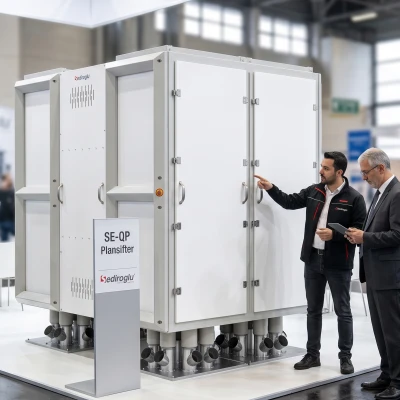
Plansifters
A plansifter uses multiple sieving sections to classify material after different milling passages.
Depending on particle characteristics, fractions can be directed toward:
• another roller mill;
• purification;
• further classification;
• flour collection;
• bran handling;
• another process stage.
This continuous relationship between milling and sifting is fundamental to modern flour production.
Purification of Intermediate Products
Some milling processes require additional separation of intermediate fractions.
Purifiers can be used where appropriate to classify material through a combination of sieving and controlled airflow.
The purpose is to direct suitable fractions toward the correct subsequent milling or processing stage.
Not every grain milling application requires the same purification configuration, so the system should be designed around the final product requirements.
Product Transport inside a Grain Mill
Processing machines need a reliable method of transferring materials from one stage to another.
A grain milling plant may contain numerous product routes connecting:
cleaning equipment → preparation → roller mills → sifters → purifiers → storage
Depending on plant design, material transfer may involve gravity, pneumatic conveying, mechanical conveying or combinations of suitable systems.
Why Product Flow Matters
A high-performance machine cannot compensate for a poorly designed product route.
Transport systems should therefore be planned together with processing machinery.
Important considerations include:
• machine positions;
• vertical levels;
• conveying distances;
• product characteristics;
• intermediate storage;
• maintenance access;
• process sequence.
An organized layout helps connect each processing stage logically.
Main Equipment Used in a Grain Mill
A complete industrial milling plant can contain many machines and auxiliary systems.
| Process Stage | Typical Equipment | Function |
| Grain intake | Receiving and conveying systems | Introduce raw grain |
| Cleaning | Grain separators | Separate unwanted materials |
| Cleaning | Destoners | Remove dense impurities |
| Cleaning | Aspiration equipment | Separate dust and light material |
| Protection | Magnetic separators | Capture ferrous contaminants |
| Preparation | Conditioning equipment | Prepare grain for milling |
| Milling | Roller mills | Controlled particle reduction |
| Classification | Plansifters | Separate milled fractions |
| Purification | Purifiers | Refine intermediate products |
| Product transfer | Conveying systems | Connect processing stages |
| Storage | Bins and silos | Hold grain and processed products |
| Final handling | Weighing and packing equipment | Prepare products for dispatch |
The exact machine list should always be determined according to the specific milling project.
Grain Mill for Wheat Processing
Wheat is one of the most important raw materials processed in industrial grain mills.
A wheat grain mill can include several cleaning, conditioning, grinding and classification stages designed around flour production.
A simplified route may be:
Raw Wheat → Cleaning → Conditioning → Roller Milling → Sifting → Purification → Flour Collection
Intermediate products can circulate through the system several times before reaching their final destination.
Flour Production in a Grain Mill
Producing flour requires controlled separation of the wheat kernel.
The milling diagram determines how material moves between roller mills, plansifters and other process equipment.
Finished flour fractions can then be collected and directed toward blending, storage, weighing or packaging according to the plant configuration.
Grain Mill for Different Cereals
The term grain mill is not limited exclusively to wheat.
Depending on equipment design and process requirements, industrial milling facilities may be developed for different cereal-processing applications.
However, different grains should not automatically be assumed to require identical processing systems.
Grain characteristics can influence:
• cleaning requirements;
• preparation;
• milling method;
• equipment configuration;
• sifting;
• final product handling.
For this reason, the process should be engineered according to the actual raw material.
Complete Grain Mill Plant
A complete grain mill plant integrates multiple processing stages into one production system.
Instead of purchasing unrelated machines, a complete project considers how raw material moves from intake to final product.
A typical project may include:
Receiving + Cleaning + Preparation + Milling + Sifting + Product Transport + Storage + Packaging
Each section should be appropriately matched to the others.
Why Plant Integration Matters
If one section is incorrectly sized or configured, it can affect downstream operations.
For example, cleaning capacity should correspond with the amount of grain entering the process, while milling and sifting sections need to operate within a coordinated production structure.
The complete system should therefore be evaluated as a connected process.
How to Choose a Grain Mill
Selecting an industrial grain mill starts with defining the project requirements.
Buying machinery before determining these requirements can lead to an inefficient plant configuration.
Required Milling Capacity
Production capacity is one of the first parameters to define.
The required throughput influences:
• machine sizing;
• number of processing units;
• storage requirements;
• conveying equipment;
• building layout;
• supporting systems.
Capacity should be evaluated across the entire line rather than assigned only to one machine.
Grain to Be Processed
The raw material should be clearly defined before equipment selection.
Important characteristics may include grain type, physical properties, moisture condition and expected raw-material quality.
This information helps determine the appropriate process configuration.
Desired Final Product
The intended output has a major influence on plant design.
Different product specifications may require different milling diagrams, classification arrangements and handling systems.
The plant should therefore be designed around what it needs to produce—not only around what enters it.
Available Space
Industrial milling machinery must fit into the physical structure of the facility.
The design should consider:
• building dimensions;
• floor levels;
• ceiling heights;
• machine access;
• service areas;
• storage zones;
• product routes;
• future expansion.
Space planning and process planning should be developed together.
Small Grain Mill vs. Industrial Grain Mill
The phrase “grain mill” can describe very different systems.
Small Grain Mills
Small-scale mills may use compact grinding equipment designed for limited production volumes.
Their layouts and processing requirements can be considerably simpler than those of industrial plants.
Industrial Grain Mills
An industrial grain mill is generally a multi-stage processing facility.
It may incorporate numerous cleaning machines, roller mills, sifters, product transport lines, storage systems and automation components.
For this reason, industrial grain milling should be approached as a process-engineering project rather than merely a machine purchase.
New Grain Mill Project
A new milling project provides the opportunity to coordinate the process layout, machinery and building from the beginning.
A typical development sequence may include:
Raw Material Analysis → Capacity Planning → Process Design → Equipment Selection → Plant Layout → Installation → Commissioning
Process Design Before Equipment Selection
The desired production flow should be established before finalizing machinery.
This allows the equipment to be selected for specific functions rather than attempting to build a process around machines that have already been chosen.
Modernizing an Existing Grain Mill
Older milling facilities can be upgraded without necessarily replacing the entire plant.
Modernization projects may involve:
• replacing outdated machines;
• upgrading grain cleaning;
• installing new roller mills;
• modifying sifting sections;
• improving product transport;
• reorganizing storage;
• introducing automation;
• changing process routes.
The existing installation should first be evaluated to determine which sections require modification.
Grain Mill Revamping
A revamping project can focus on selected areas of the mill while retaining suitable existing equipment.
Compatibility is particularly important.
New machinery should be evaluated against existing capacity, product flow, available space, connections and process requirements.
Automation in Modern Grain Mills
Modern grain mills may combine mechanical processing equipment with electrical control and automation technologies.
Automation can support centralized monitoring of different production areas.
Depending on the system, operators may monitor equipment status, product routing and selected process conditions.
Centralized Process Control
Because milling plants contain interconnected machines, visibility across the production line can help operators understand how different sections are functioning.
Automation should complement the mechanical process design rather than replace the need for correct equipment selection and plant engineering.
Grain Mill Maintenance
Maintenance requirements should be considered from the design stage.
Equipment needs sufficient access for inspection, cleaning and servicing.
Maintenance planning can include:
• roller inspection;
• sieve inspection;
• drive components;
• conveying equipment;
• bearings;
• product-contact areas;
• connections;
• aspiration systems;
• safety components.
Specific procedures and intervals should follow the requirements of the installed machinery.
Hygiene in Grain Milling
Grain mills process food or food-related raw materials, making hygienic plant design an important consideration.
Depending on the application, attention may be given to:
• accessible surfaces;
• cleaning points;
• dust control;
• product accumulation areas;
• contamination prevention;
• appropriate material selection;
• inspection access.
Applicable requirements should be evaluated according to the plant location, product and relevant regulations.
Dust Management in a Grain Mill
Handling and processing dry grain can generate dust at different points of the production line.
Dust management should therefore be considered as part of the complete facility design.
Potential areas requiring attention include grain intake, transfer points, cleaning machinery, milling sections and product handling areas.
The appropriate dust-control solution depends on the actual process and installation.
Energy Considerations
A grain mill consumes energy across multiple systems.
Energy demand can come from:
• milling machinery;
• pneumatic conveying;
• mechanical conveying;
• aspiration;
• cleaning equipment;
• auxiliary systems.
For this reason, energy performance should be considered at plant level rather than judging efficiency from one machine alone.
Correct sizing and coordination between equipment are important parts of overall system design.
Grain Mill Equipment vs. Grain Mill Plant
These terms are closely related but describe different scopes.
Grain mill equipment generally refers to individual machines or equipment groups used in milling.
A grain mill plant describes the complete processing facility where those machines operate together.
Understanding this distinction can help buyers define whether they need a single machine, a production section or an entire turnkey milling solution.
What Should Be Considered Before Buying a Grain Mill?
Before requesting machinery or a complete milling system, buyers should define the basic project parameters.
| Project Requirement | Information Needed |
| Raw material | Grain to be processed |
| Capacity | Required production rate |
| Final products | Desired output |
| Project | New plant or modernization |
| Facility | Available building dimensions |
| Existing equipment | Relevant for upgrades |
| Storage | Raw and finished product requirements |
| Automation | Required control level |
| Installation location | Project destination |
Providing accurate information allows the technical configuration to be developed around the real project requirements.
Grain Mill Manufacturer and Equipment Selection
When evaluating a grain mill manufacturer, buyers should look beyond a single machine specification.
Industrial milling projects can involve process engineering, machinery, product transfer, automation, installation planning and technical support.
The suitability of a supplier therefore depends on the scope of the project and the equipment required.
A complete technical evaluation should focus on how the proposed machinery fits into the desired milling process.
Grain Mill Solutions from SEDIROGLU GROUP
SEDIROGLU GROUP provides equipment solutions for grain processing and flour milling applications.
Projects can involve individual milling machines, replacement equipment, process sections or broader plant requirements depending on the application.
For a new grain mill or modernization project, equipment should be selected according to the grain being processed, required production capacity, final product specifications, plant layout and existing infrastructure.
Why the Right Grain Mill Design Matters
A successful milling operation depends on the relationship between all stages of production.
Cleaning prepares the grain. Preparation supports the milling process. Milling creates different fractions. Sifting classifies those fractions. Product transport directs them toward the correct next stage.
The process can therefore be viewed as:
Clean → Prepare → Mill → Classify → Transfer → Collect
Each stage has a specific purpose.
A well-designed grain mill brings these operations together into a coordinated production system.
Conclusion
A grain mill is the center of a multi-stage process that transforms raw cereal grains into flour and other milled products. In industrial applications, successful milling depends on much more than grinding equipment alone.
Cleaning machines, preparation systems, roller mills, plansifters, purifiers, conveying equipment, storage and final product handling all contribute to the complete process.
When planning a new grain mill, important factors include the type of grain, required production capacity, final products, available building space and desired automation level. For an existing plant, compatibility with current equipment and process routes is equally important.
Selecting equipment around the complete process rather than isolated machines creates a more coherent foundation for an industrial grain milling plant.
Frequently Asked Questions About Industrial Flour and Feed Milling Technologies
"At Sediroglu Group, we provide turnkey solutions including flour and feed mill equipment, conveying section equipment, grinding section equipment, and packaging section equipment. We have compiled the most frequently asked questions about our high-efficiency solutions, technical details, and capacity options tailored to your facility. If you have any further questions or require technical consultancy for your project, please contact our expert team."
In industrial applications, a grain mill can include cleaning, preparation, grinding, sifting, purification, conveying and storage equipment. The exact configuration depends on the grain, required capacity and desired final product.
Raw grain is generally received and cleaned before preparation and milling. The resulting particles are then sifted and classified, while different fractions may be returned for further processing or directed toward flour collection, storage or other destinations.
The machine configuration varies according to the raw material and production objective. Industrial flour mills may also require conditioning equipment, aspiration systems, magnetic separators, weighing systems and packaging machinery.
The complete process should be evaluated before choosing individual machines. Grain characteristics, building layout, storage requirements, product routes, automation needs and future expansion plans can all influence the final equipment configuration.
Blog Latest Posts
Flour Mill Grinder
Mill Grains | Grain Milling Machines & Processing Solutions