- Sediroglu Group
- 15 September 2026
Flour Mill Grinder
A flour mill grinder is one of the most important parts of an industrial flour milling system. Its purpose is not simply to crush wheat into smaller particles. Modern flour grinding is a controlled, multi-stage process designed to separate the valuable endosperm from bran and germ while producing flour with the required particle size, quality and consistency.
In industrial wheat flour production, grinding and sifting work together through several passages. Wheat is gradually opened, reduced and classified instead of being ground into finished flour in a single step. This controlled approach helps flour mills achieve consistent production, better separation and efficient use of the grain.
SEDIROGLU GROUP manufactures flour milling machinery and equipment for modern wheat processing plants, including grinding, sifting, conveying, cleaning, packing and supporting systems.
What Is a Flour Mill Grinder?
The term flour mill grinder can refer to machinery used to reduce wheat or other grains into flour, meal or intermediate particles during the milling process.
In a modern industrial flour mill, however, grinding should be understood as a system rather than a single crushing operation. Wheat passes through a sequence of grinding and classification stages. Different fractions are separated and directed to the next appropriate processing step.
The objective is to control how the wheat kernel is opened and how the endosperm is gradually separated from the bran.
For commercial and industrial flour production, this makes the grinding system significantly different from a small household grain grinder.
How Does an Industrial Flour Mill Grinder Work?
Industrial wheat grinding begins after the grain has been properly cleaned and conditioned.
Prepared wheat enters the milling section, where roller mills progressively open the kernels. After grinding, the resulting material contains particles of different sizes, including flour, semolina, middlings and bran-containing fractions.
These particles are then classified by sifting equipment. Material that requires additional grinding is directed to another milling passage, while sufficiently fine flour can move toward collection, storage or further processing.
This creates a repeating process:
Grinding → Sifting → Classification → Regrinding → Final Separation
The exact flow depends on wheat characteristics, desired flour specifications, plant design and production objectives.
Why Wheat Is Not Ground Into Flour in One Step
A common misconception is that an industrial flour grinder simply pulverizes wheat until flour is produced.
Modern wheat milling is much more controlled.
If wheat were aggressively reduced in a single operation, bran could be fragmented excessively and become more difficult to separate from the flour-producing endosperm. Instead, industrial milling uses successive passages to gradually release and reduce the endosperm.
This is one of the fundamental differences between simple grain crushing and professional flour milling.
The grinding system must therefore balance several objectives:
- • Effective opening of the wheat kernel
- • Controlled particle-size reduction
- • Separation of endosperm from bran
- • Consistent flour granulation
- • Efficient extraction of usable flour
- • Stable operation throughout the milling process
Roller Mill: The Core of Modern Flour Grinding
The roller mill is a central grinding machine in modern wheat flour production.
Rather than relying on a single aggressive grinding action, roller milling allows grain and intermediate products to pass through controlled grinding stages. Roll configuration, surface characteristics, grinding gap, feeding conditions and the milling diagram influence how the material is processed.
SEDIROGLU GROUP provides roller mill and stone mill equipment for different milling requirements.
A correctly designed roller milling system can process wheat progressively while allowing downstream sifters and other machines to classify the resulting material.
Break Grinding
The first major objective is to open the wheat kernel and begin releasing the endosperm.
Break passages are not intended simply to produce as much fine flour as possible immediately. Instead, the system progressively opens the grain and generates fractions that can be separated and processed through subsequent stages.
The condition of the wheat entering these passages is therefore extremely important.
Reduction Grinding
After the earlier separation stages, suitable intermediate products can be directed to reduction passages.
Here, the objective shifts toward reducing relatively clean endosperm-rich particles into finer flour.
Break and reduction systems therefore perform different jobs within the same overall flour grinding process.
Grinding Gap and Particle Size Control
Particle size is one of the most important considerations in flour grinding.
The grinding gap and operating settings must correspond to the material entering each passage. Excessively aggressive grinding can negatively affect separation, while insufficient grinding may leave too much material requiring additional processing.
For this reason, a professional industrial flour grinder should not be evaluated only by how finely it can grind.
It should be evaluated by how effectively it performs its assigned function within the complete milling diagram.
This is why flour mill design, machine selection and process engineering must be considered together.
Grinding and Sifting Must Work Together
A flour mill grinder cannot operate efficiently in isolation.
After each important grinding stage, the material needs to be separated according to particle size and process destination. This is where the plansifter becomes essential.
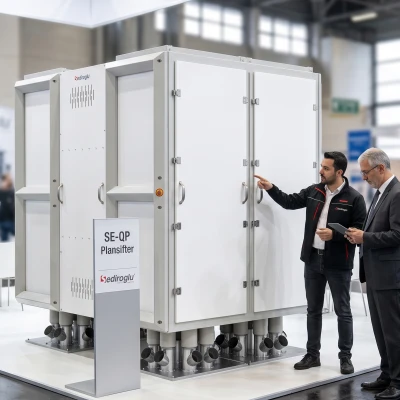
A plansifter separates and classifies flour, semolina and other intermediate milling products so that each fraction can be directed to the appropriate next stage.
Some material may already meet the required flour granulation.
Other material may need additional reduction.
Coarser particles may be returned to another grinding passage.
Bran-rich fractions may require different processing.
This repeated interaction between roller mills and plansifters is one of the defining characteristics of industrial wheat flour milling.
The Relationship Between Grinding and Flour Quality
Flour quality does not depend only on the final particle size.
The way wheat is prepared, ground, separated and classified throughout the process influences the final product.
Important considerations include:
Granulation: Flour and intermediate particles must be produced and classified according to the intended product.
Bran separation: Effective separation helps limit unwanted bran contamination in flour streams where lower bran content is required.
Starch damage: Grinding intensity can influence starch damage, which in turn can affect flour behavior and water absorption.
Consistency: Stable machine settings and product feeding help maintain more uniform production.
Wheat characteristics: Hardness, moisture, variety and kernel condition influence how wheat behaves during grinding.
Therefore, the best flour grinding system is not necessarily the one that performs the most aggressive grinding. It is the system that produces the desired flour characteristics through controlled processing.
Why Wheat Conditioning Matters Before Grinding
Efficient grinding begins before wheat reaches the roller mill.
Cleaning removes unwanted foreign materials, while conditioning prepares the wheat kernel for the milling process. Moisture management and tempering influence the physical behavior of the bran and endosperm during grinding.
Properly prepared wheat can support more effective separation during the milling process.
For this reason, the performance of a wheat flour grinder should always be evaluated as part of the complete process rather than independently from grain preparation.
Roller Mill vs. Stone Mill
Roller mills and stone mills can both be used for grain grinding, but they represent different milling approaches.
Modern roller milling is especially suitable for industrial processes requiring controlled, progressive grinding and repeated classification.
Stone milling uses grinding stones to process the grain and can be selected for particular flour characteristics, traditional milling concepts or specific product requirements.
SEDIROGLU GROUP's Stone Mill provides an alternative grinding solution for applications where stone milling is preferred.
The correct choice depends on the desired final product, production method, capacity requirements and process design.
When Is a Roller Mill Preferred?
Roller mills are particularly suitable when the milling process requires multiple controlled passages and close integration with plansifters, purifiers and other flour milling equipment.
They are widely associated with modern industrial wheat flour production.
When Is a Stone Mill Preferred?
A stone mill can be considered when the required production concept specifically calls for stone grinding.
Rather than treating one technology as universally superior, flour mill operators should select equipment according to the flour they intend to produce and the complete process configuration.
The Role of Purification in Flour Grinding
Not every intermediate product leaving a grinding and sifting stage should immediately be reduced into flour.
Certain semolina and middling fractions can contain bran particles that need further separation.
Purification helps separate cleaner endosperm-rich particles from bran-containing fractions before additional grinding.
This illustrates an important principle of industrial milling:
Grinding quality depends on separation quality.
Simply adding more grinding power does not automatically produce better flour. The process must correctly identify, separate and route different particle fractions.
Impact Detachers and Intermediate Products
Some milling diagrams use impact detachers to treat intermediate stocks between grinding and sifting stages.
Their role differs from the primary roller grinding operation. They can assist in releasing flour particles from compressed intermediate material before subsequent classification.
The need for detachers depends on the mill flow diagram and processing requirements.
This is another reason why selecting a flour mill grinder should not be reduced to choosing a single machine based only on motor power or nominal capacity.
Bran Finishing and Product Recovery
After the main grinding and separation stages, bran may still carry useful floury material.
Bran finishing equipment can help recover remaining endosperm while keeping the bran stream separate from the main flour streams.
A well-designed flour milling system therefore considers not only grinding performance but also how effectively valuable product is recovered throughout the complete process.
Industrial Flour Grinder vs. Small Grain Grinder
A small grain grinder machine and an industrial flour milling system serve very different purposes.
Small grinders may reduce grain directly into meal or flour in one or a limited number of operations.
Industrial flour mills are designed around continuous processing, controlled separation and repeated passages.
An industrial installation may include:
- Roller mills
- Plansifters
- Purifiers
- Impact detachers
- Bran finishers
- Pneumatic conveying equipment
- Screw conveyors
- Aspiration systems
- Flour collection systems
- Storage equipment
- Weighing and packing systems
- Automation and process control
For this reason, buyers searching for a commercial flour mill grinder should first determine whether they need an individual grinding machine or a complete industrial milling solution.
Material Flow Is Critical to Grinding Performance
Once wheat enters the milling section, intermediate products must move reliably between different machines and passages.
Depending on the plant configuration, this movement can involve gravity flow, pneumatic conveying and mechanical conveying systems.
Correct product routing is important because every fraction needs to reach the correct machine at the correct stage.
A poorly designed conveying layout can affect the efficiency of an otherwise well-selected grinding system.
For particular material-handling requirements, equipment such as a tubular screw conveyor can be integrated into suitable parts of the production system.
From Grinding to Finished Flour
Grinding is not the end of flour production.
Once the required flour fractions have been produced and classified, they may be collected in flour bins or silos, blended according to production requirements and prepared for packing or bulk dispatch.
Packing equipment therefore represents an important downstream stage of a complete flour production line.
For industrial bagging requirements, SEDIROGLU GROUP manufactures solutions including the Flour Packing Machine 25–50 Kg Double Weighing Single Spout.
This creates a complete production path from prepared wheat through controlled grinding and classification to finished flour ready for commercial distribution.
Wheat Flour Grinding
Wheat is the primary focus of many industrial flour milling plants.
The grinding diagram must take into account wheat properties and the required final flour specifications. Different wheat varieties and blends can behave differently during conditioning, break grinding, purification and reduction.
For this reason, there is no single grinder setting that is ideal for every wheat and every flour product.
Professional milling requires process control and adjustment according to raw material and production targets.
Durum Wheat Grinding
Durum wheat processing has different product objectives from conventional bread-wheat flour milling.
Semolina production places particular emphasis on producing and purifying suitable granular endosperm fractions. Roller mills, plansifters and purifiers can therefore play important interconnected roles in a durum milling system.
The process configuration should be developed according to the desired semolina or flour specifications.
Corn Grinding
Corn can also be processed through industrial milling systems, but corn milling should not simply be treated as identical to wheat milling.
Kernel structure, preparation requirements, desired end products and milling diagrams can differ significantly.
Equipment selection should therefore be based on the specific raw material and final product rather than applying a wheat milling diagram unchanged to every grain.
How to Choose a Flour Mill Grinder
Choosing the right flour grinding machine requires more than comparing machine dimensions or motor specifications.
A mill owner or investor should first define:
1. Raw Material
Is the plant processing bread wheat, durum wheat, corn or another grain?
2. Desired Final Product
Will the plant produce bakery flour, semolina, whole wheat flour or another product?
3. Required Production Capacity
Grinding equipment must be selected according to the capacity and flow diagram of the complete plant.
4. Milling Diagram
The number and arrangement of grinding, sifting, purification and auxiliary passages influence machine selection.
5. Existing or New Plant
Equipment selection for a new turnkey flour mill can be approached differently from replacing or upgrading machinery in an existing plant.
6. Automation Requirements
Modern plants can integrate centralized control and automation to monitor and manage production.
7. Maintenance and Spare Parts
Long-term equipment operation also depends on maintenance accessibility, technical support and spare-parts availability.
Flour Mill Grinder for New Milling Plants
For a new flour mill project, the grinding section should be designed as part of the complete production flow.
Machine quantity, roller configuration, sifting area, pneumatic transport, aspiration, intermediate product routing and finished flour handling must work together.
SEDIROGLU GROUP provides machinery and engineering solutions for flour milling projects with capacities ranging from 45 to 500 tons per 24 hours, depending on project requirements and plant configuration.
Available standard plant capacities include:
45, 60, 80, 100, 120, 150, 180, 200, 220, 250, 300, 350, 400, 450 and 500 tons/24h.
The appropriate configuration is determined according to raw material, required flour characteristics, capacity and project conditions.
Upgrading an Existing Flour Grinding System
Building a completely new plant is not always necessary.
Existing flour mills may require modernization because of aging machinery, changing production requirements, capacity expansion or the need for improved process control.
Depending on the condition of the plant, modernization can involve replacing selected roller mills, increasing sifting capacity, modifying product routes, upgrading conveying equipment or improving automation.
The existing milling diagram should be evaluated before individual machines are selected.
This prevents the common mistake of installing a new grinder without considering whether surrounding equipment can properly handle its production.
Grinding Capacity Should Be Considered as a System
A machine's nominal throughput alone does not define the actual production capacity of a flour mill.
Overall performance can be influenced by:
- Wheat characteristics
- Conditioning
- Grinding diagram
- Roller configuration
- Sifting capacity
- Purification
- Product conveying
- Aspiration
- Storage
- Packing capacity
- Automation
- Plant layout
For this reason, industrial flour milling capacity should be evaluated at the system level.
A high-capacity grinder cannot by itself create a high-capacity flour mill if downstream equipment becomes a bottleneck.
Maintenance of Flour Grinding Equipment
Regular maintenance supports stable operation and helps reduce unexpected production interruptions.
Maintenance programs should be based on the specific machine design and manufacturer recommendations, but common areas of attention include grinding surfaces, bearings, drive systems, feeding mechanisms, seals, aspiration connections and machine cleanliness.
Operators should also monitor changes in product granulation and grinding behavior.
A mechanical problem may first become visible as a change in milling performance before it results in a complete machine stoppage.
Energy Efficiency in Flour Grinding
Grinding is an important energy-consuming stage of flour production, which makes process efficiency relevant to operating costs.
However, energy efficiency should not be pursued by considering the grinder alone.
Correct wheat preparation, stable feeding, appropriate grinding settings, efficient product classification and a properly balanced milling diagram can all influence overall performance.
The objective is to use the necessary grinding action efficiently while maintaining the required flour quality and production capacity.
Flour Mill Grinder and Process Automation
Modern industrial milling plants can use automation to improve production monitoring and process control.
Centralized systems can help operators observe equipment status, production conditions and alarms from a central interface.
Automation does not replace correct milling technology. Instead, it provides operators with tools for managing a correctly designed process more consistently.
SEDIROGLU GROUP can integrate PLC, SCADA and central automation solutions into complete flour milling projects according to project requirements.
Individual Grinder or Complete Flour Milling System?
Some customers need only a replacement grinding machine.
Others require an entire milling section.
New investors may need a complete turnkey flour mill.
These are very different projects.
Before purchasing equipment, buyers should determine whether the requirement is:
Individual machine replacement
A particular existing machine needs to be replaced.
Milling section modernization
Several machines or process passages need upgrading.
Capacity expansion
The existing system needs additional production capability.
Complete flour mill project
The customer requires an integrated plant from grain reception through finished flour packing.
This distinction helps ensure that the selected equipment solves the actual production requirement.
SEDIROGLU GROUP Flour Milling Solutions
SEDIROGLU GROUP manufactures machinery for flour mills and grain processing facilities and provides solutions for both individual equipment requirements and complete industrial projects.
Our flour milling solutions can include grain cleaning and preparation, grinding, sifting, purification, conveying, aspiration, flour handling, weighing, packing, laboratory equipment, electrical systems and automation.
For turnkey projects, the scope can also include project engineering, manufacturing, shipment, installation, commissioning and technical support according to project requirements.
Our objective is to create a coordinated production system rather than simply placing individual machines inside a building.
From Wheat Kernel to Finished Flour
A modern flour mill grinder is best understood as part of an integrated milling process.
The journey from wheat to flour depends on controlled grinding, accurate classification and intelligent product routing. Roller mills gradually open and reduce the grain. Plansifters classify the resulting particles. Purifiers, detachers and bran finishers can
support further separation and product recovery where required by the milling diagram.
The result is not created by one machine alone.
It is created by the interaction of machines, process engineering and correct operating parameters.
For investors planning a new flour mill and millers modernizing an existing production line, choosing the right grinding technology should therefore begin with the desired final product and the complete process flow.
SEDIROGLU GROUP provides industrial flour milling machinery and complete processing solutions for flour mills worldwide.
Frequently Asked Questions About Industrial Flour and Feed Milling Technologies
"At Sediroglu Group, we provide turnkey solutions including flour and feed mill equipment, conveying section equipment, grinding section equipment, and packaging section equipment. We have compiled the most frequently asked questions about our high-efficiency solutions, technical details, and capacity options tailored to your facility. If you have any further questions or require technical consultancy for your project, please contact our expert team."
Machine selection should begin with the required final product rather than motor power or grinder size alone. Wheat characteristics, targeted flour quality, daily capacity, sifting area, conveying system, automation and existing plant conditions should all be evaluated. For complete projects, designing the grinding equipment as part of the entire milling flow provides a more effective approach than selecting individual machines independently.
Material leaving a roller mill contains particles with different sizes and characteristics. The plansifter separates these fractions so finished flour can be collected while coarser or intermediate material can be sent to additional grinding or other processing stages. This repeated grinding-and-sifting cycle is fundamental to modern industrial wheat milling.
Roller milling is particularly suited to multi-stage industrial flour production where grinding and sifting are repeated through several passages. Stone milling uses a different grinding principle and may be selected for particular traditional or specialty flour applications. The best option depends on the desired product, required capacity and overall production process.
Industrial wheat mills commonly use roller mills together with plansifters, purifiers and other milling-section equipment. The roller mill performs controlled grinding, while the plansifter separates the resulting material according to particle size and process destination. The exact machine configuration depends on wheat characteristics, required flour specifications, production capacity and the milling diagram.
In industrial flour milling, a flour mill grinder is normally part of a multi-stage grinding and separation system. Wheat passes through controlled grinding passages, while sifters classify the resulting particles and direct them toward additional grinding, purification or finished flour collection. This allows the mill to separate endosperm from bran progressively instead of pulverizing the complete kernel in a single operation.
Blog Latest Posts
Mill Grains | Grain Milling Machines & Processing Solutions
Flour Milling Machine | Equipment & Turnkey Flour Mills