- Sediroglu Group
- 18 August 2026
Wheat Milling Equipment
Wheat Milling Equipment: Complete Guide to Modern Flour Mill Machinery
Wheat milling is much more than grinding grain into flour. A modern flour mill is an integrated processing system in which wheat passes through several carefully organized stages before becoming a finished product.
The process may include receiving, cleaning, separating foreign materials, conditioning, grinding, sifting, purification, flour collection and final product handling. Each stage requires equipment designed for a specific purpose and the performance of one section can influence the operation of the next.
For this reason, selecting the right wheat milling equipment requires understanding the entire milling process rather than evaluating individual machines separately.
Modern flour milling plants combine different machines into a coordinated production line where wheat and intermediate products move continuously between processing stages.
This guide explains the main equipment used in wheat flour production, how the machines work together and what businesses should consider when planning a new mill or upgrading an existing facility.
What Is Wheat Milling Equipment?
Wheat milling equipment refers to the machinery and systems used to transform raw wheat into flour and related milling products.
Rather than describing a single machine, the term covers a complete group of equipment used throughout the flour production process.
A typical wheat milling plant may include machinery for:
- wheat receiving and handling;
- preliminary and fine cleaning;
- separation of foreign materials;
- wheat conditioning;
- grinding and reduction;
- sifting and classification;
- purification;
- product collection;
- flour handling;
- bran handling;
- pneumatic or gravity-based product transfer;
- weighing and packaging.
The exact configuration depends on the mill's production goals, wheat characteristics, required flour specifications and overall plant design.
Is a Wheat Mill One Machine?
No. Industrial wheat milling generally requires a combination of machines operating as a connected system.
A roller mill, for example, performs an important grinding function, but grinding alone does not create a complete industrial flour production process.
The wheat must first be prepared. After grinding, the resulting material must also be classified and directed to the appropriate subsequent stages.
This is why flour mill design should focus on the complete process flow.
How Does the Wheat Milling Process Work?
Although plant configurations vary, industrial wheat flour production can generally be divided into several major stages.
A simplified process flow may look like:
Wheat Receiving → Cleaning → Conditioning → Grinding → Sifting → Purification → Flour Collection → Storage or Packaging
Each section has a different purpose.
1. Wheat Receiving
The process begins when raw wheat enters the facility.
Depending on the plant design, wheat may arrive from trucks, storage facilities or silos before being transferred into the processing line.
At this stage, handling equipment helps direct the grain toward storage or cleaning sections.
2. Wheat Cleaning
Raw wheat can contain unwanted materials that should be separated before milling.
The cleaning section is therefore one of the most important areas of a flour mill.
Depending on the raw material and plant configuration, cleaning equipment may help separate:
- dust;
- light impurities;
- stones;
- foreign grains;
- metallic contaminants;
- oversized materials;
- undersized particles;
- other unwanted matter.
A well-designed cleaning line prepares the wheat for the following production stages.
Essential Wheat Cleaning Equipment
Different contaminants require different separation principles. Therefore, industrial cleaning systems typically use several machines rather than relying on a single cleaner.
Grain Separator
A grain separator helps classify incoming material according to physical characteristics such as size.
Screens can separate unwanted materials that are larger or smaller than the wheat kernels.
The separator can therefore serve as an important early stage in wheat preparation.
Destoner
Stones and other high-density foreign materials may require a different separation method.
A destoner is designed to separate heavier contaminants from the grain stream according to differences in physical properties.
Removing these materials before milling is important for both process preparation and downstream equipment.
Aspiration Equipment
Light impurities and dust may be separated using controlled airflow.
Aspiration equipment can therefore complement mechanical cleaning machines by addressing contaminants that behave differently from wheat under air movement.
Magnetic Separation
Metallic contamination requires another approach.
Magnets or magnetic separators may be installed at selected points to capture ferrous metal particles before they reach sensitive processing equipment.
Together, these systems create a multi-stage cleaning process rather than depending on one separation method.
Wheat Conditioning Before Milling
After cleaning, wheat may undergo conditioning before entering the main grinding process.
Conditioning generally involves controlling moisture and allowing the grain to rest under defined process conditions.
The objective is to prepare the kernel structure for subsequent milling operations.
Why Is Wheat Conditioning Important?
Wheat consists of different structural components, including the bran layers and endosperm.
The milling process aims to separate and reduce these components in a controlled manner rather than simply crushing the entire kernel at once.
Proper preparation supports the following grinding and separation stages.
The exact conditioning parameters depend on wheat characteristics and the required milling process.
Roller Mills: Core Wheat Grinding Equipment
The roller mill is one of the central machines in modern wheat flour production.
Instead of processing wheat through a single grinding action, industrial milling typically uses multiple grinding passages.
Material moves through a sequence of roller mills, sifters and related equipment.
How Does a Roller Mill Work?
Roller mills use rotating rolls to process wheat and intermediate milling products.
Different passages can perform different functions depending on the mill diagram.
The objective is controlled size reduction and separation throughout several processing stages.
Break System
The break system begins opening the wheat kernel and releasing material from the bran structure.
Rather than immediately producing all finished flour, the process generates different particle fractions.
These fractions are subsequently classified.
Reduction System
Suitable intermediate fractions can continue through reduction passages.
The reduction process progressively decreases particle size and contributes to flour production.
This staged approach is one of the fundamental characteristics of modern roller milling.
Plansifters and Particle Classification
Grinding and sifting work together.
After material passes through a roller mill, it contains particles of different sizes and characteristics. These fractions need to be separated before the process can determine where they should go next.
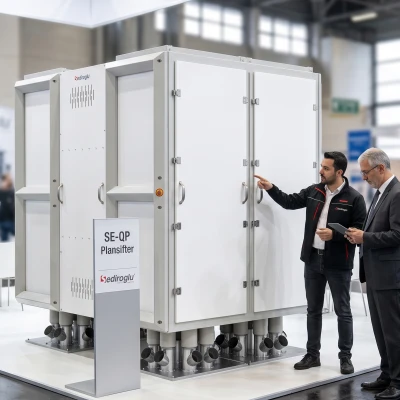
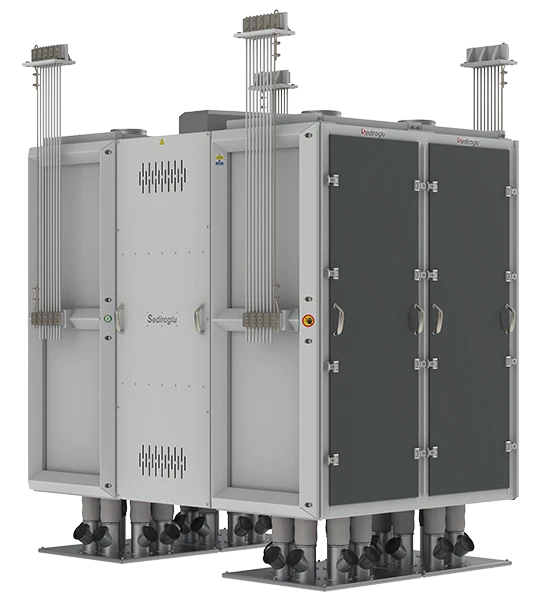
A plansifter performs this classification function.
What Does a Plansifter Do?
Plansifters use multiple sieve sections to classify milled material into different particle-size groups.
Depending on the milling diagram, separated fractions may be directed toward:
- another roller mill;
- a purification stage;
- another sifting passage;
- flour collection;
- bran handling;
- another processing section.
Therefore, a plansifter is not simply a final flour sieve. It forms part of the continuous decision-making structure of the milling process.
Purifiers in Wheat Flour Milling
Certain intermediate products may require additional separation before further reduction.
A purifier is used in appropriate milling stages to improve the classification of these intermediate fractions.
Purification typically combines sieving with controlled airflow to separate particles according to relevant physical characteristics.
Why Are Purifiers Used?
Intermediate products can contain particles with different compositions even when their dimensions are relatively similar.
A purifier helps prepare suitable fractions for subsequent processing.
Its exact role depends on the milling diagram and the flour products being produced.
Product Flow Between Milling Machines
One of the less visible but essential parts of a flour mill is the product transport system.
Material must continuously move between:
roller mills → plansifters → purifiers → collection points → storage or further processing
Depending on plant design, transport may involve gravity systems, pneumatic conveying and other suitable conveying solutions.
An efficient layout should therefore consider not only individual machines but also how materials move between them.
Main Wheat Milling Equipment in a Flour Mill
A complete plant can contain many machines, but the main equipment categories can be summarized as follows:
| Processing Stage | Typical Equipment | Primary Function |
| Receiving | Conveying and intake equipment | Introduce wheat into the plant |
| Cleaning | Separators | Remove unwanted materials |
| Cleaning | Destoners | Separate dense impurities |
| Cleaning | Aspiration systems | Remove light particles and dust |
| Protection | Magnetic separators | Capture ferrous contaminants |
| Preparation | Conditioning equipment | Prepare wheat for milling |
| Grinding | Roller mills | Controlled size reduction |
| Classification | Plansifters | Separate milled fractions |
| Purification | Purifiers | Refine intermediate fractions |
| Transfer | Conveying systems | Move products between machines |
| Storage | Bins and silos | Hold raw, intermediate or final products |
| Final handling | Weighing and packing equipment | Prepare finished flour for dispatch |
The final machine list should be developed according to the actual process requirements of the plant.
How to Choose Wheat Milling Equipment
Selecting equipment should begin with process requirements rather than individual machine specifications.
Several questions should be answered during project planning.
Required Production Capacity
The desired production capacity influences the scale and configuration of the plant.
A small milling facility and a high-capacity industrial flour mill will not necessarily require the same number, size or arrangement of machines.
Capacity planning should consider the complete production line so that one section does not unnecessarily restrict another.
Type and Characteristics of Wheat
Different wheat varieties and raw material conditions can influence milling behavior.
Relevant factors may include:
- kernel characteristics;
- moisture;
- hardness;
- cleanliness;
- expected flour products;
- raw material consistency.
Equipment selection should therefore reflect the wheat that will actually be processed.
Required Final Products
Not every flour mill has the same production target.
A plant may be designed to produce one main flour specification or several product streams.
The required output influences the milling diagram, machine configuration, sifting arrangement and product handling system.
Available Building Space
Plant layout has a major impact on equipment arrangement.
Engineers should evaluate:
- floor area;
- building height;
- number of floors;
- machine access;
- maintenance areas;
- product flow;
- storage locations;
- future expansion possibilities.
A technically suitable machine must also fit logically into the complete plant.
New Flour Mill Projects
Planning a new wheat flour mill provides the opportunity to design the process and building layout together.
A typical project may involve:
capacity definition → process design → equipment selection → layout planning → installation → commissioning
The relationship between these stages is important.
Choosing machinery before defining the process can create unnecessary limitations later in the project.
Process Flow Should Come First
Before finalizing equipment, the production route should be understood.
Engineers need to know where wheat enters, how it is cleaned, how it reaches the milling section, how intermediate products circulate and where finished flour is collected.
Once these flows are defined, equipment can be positioned around the process requirements.
Upgrading Existing Wheat Mills
Not every project starts from an empty building.
Existing flour mills may require modernization to replace older machinery, modify production flows or introduce new equipment.
This type of project may involve:
• replacing individual machines;
• upgrading roller mills;
• modifying the cleaning section;
• reorganizing product transfer;
• installing new sifters;
• improving automation;
• changing storage arrangements;
• adding new processing capacity.
A retrofit should be planned around the existing plant rather than treated as a completely new installation.
Automation in Modern Wheat Milling Equipment
Modern flour mills increasingly integrate mechanical equipment with electrical control and automation systems.
Automation can help operators monitor different stages of the production process from a centralized control environment.
Depending on the plant, monitored parameters may include equipment status, product routing, process conditions and production-related information.
Why Is Automation Important?
A flour mill contains many interconnected machines.
If one section stops or operates outside its intended condition, other parts of the process may also be affected.
Integrated monitoring can provide operators with clearer information about plant operation and support coordinated production management.
Maintenance of Wheat Milling Machinery
Equipment selection should also consider long-term maintenance.
A machine that performs well but is difficult to inspect, clean or service can create operational challenges.
During plant design, sufficient access should be considered for:
• inspection;
• cleaning;
• component replacement;
• lubrication where required;
• belt or drive maintenance;
• sieve access;
• roller maintenance;
• routine service operations.
Maintenance requirements vary by machine and manufacturer, so equipment-specific instructions should always be followed.
Energy Use in Flour Milling Plants
Energy consumption should be evaluated across the complete process rather than focusing on a single machine.
Grinding, pneumatic transport, aspiration, conveying and other systems can all contribute to total plant energy demand.
Efficient system design therefore requires appropriate equipment sizing and coordination between processing stages.
Oversized or poorly matched equipment does not automatically create a better milling plant.
Food Safety and Hygiene Considerations
Wheat milling equipment operates in a food-production environment, making hygiene and contamination control important considerations.
Plant design can include attention to:
• accessible cleaning areas;
• dust management;
• appropriate product-contact surfaces;
• controlled product flow;
• prevention of unwanted material accumulation;
• inspection access;
• separation of raw and finished product areas where required.
Applicable food-safety and regulatory requirements depend on the market and location of the facility.
Wheat Milling Equipment for Different Plant Capacities
There is no single equipment configuration suitable for every flour mill.
Production capacity affects the number and size of machines as well as the overall plant layout.
Small and Medium Flour Mills
Smaller facilities may prioritize compact layouts and simplified process configurations while still requiring the essential stages of cleaning, preparation, milling and classification.
The design should be based on actual production targets rather than simply reducing the size of a larger plant.
Large Industrial Flour Mills
Higher-capacity plants may require additional grinding passages, larger sifting capacity, more complex product routing and greater storage or handling capacity.
The important factor is maintaining balance between the individual sections of the plant.
Complete Wheat Milling Line vs. Individual Machines
A buyer searching for wheat milling equipment may be looking for either a complete flour mill or a single replacement machine.
These are two very different purchasing requirements.
Complete Flour Milling Plant
A complete project may include:
cleaning + conditioning + milling + sifting + purification + conveying + storage + control systems
Such projects require integrated engineering because each machine affects the operation of the surrounding equipment.
Individual Wheat Milling Machines
Existing plants may only require a particular machine or component.
Examples can include:
• roller mills;
• plansifters;
• purifiers;
• grain separators;
• destoners;
• conveying equipment;
• replacement components.
In these cases, compatibility with the existing process and equipment arrangement becomes particularly important.
What Information Is Needed Before Requesting a Quote?
Providing detailed project information can make technical evaluation more effective.
Useful information may include:
| Project Information | Details to Define |
| Raw material | Wheat type and characteristics |
| Target capacity | Required production rate |
| Final product | Required flour/product specifications |
| Project type | New plant or modernization |
| Building | Available dimensions and levels |
| Existing machinery | Relevant for retrofit projects |
| Automation | Required control level |
| Destination | Country / installation location |
The actual information required will vary according to the scope of the project.
Why Complete System Design Matters
A flour mill should not be evaluated as a collection of unrelated machines.
The performance of the plant depends on how the individual stages interact.
Cleaning affects the material entering conditioning. Conditioning affects milling behavior. Grinding creates fractions that must be correctly classified. Classification determines subsequent product routes.
This relationship can be summarized as:
Preparation → Milling → Classification → Routing → Final Product
A weakness in one stage can influence the efficiency of the stages that follow.
For this reason, wheat milling equipment selection should be approached as a complete process-engineering task.
Wheat Milling Equipment from SEDIROGLU GROUP
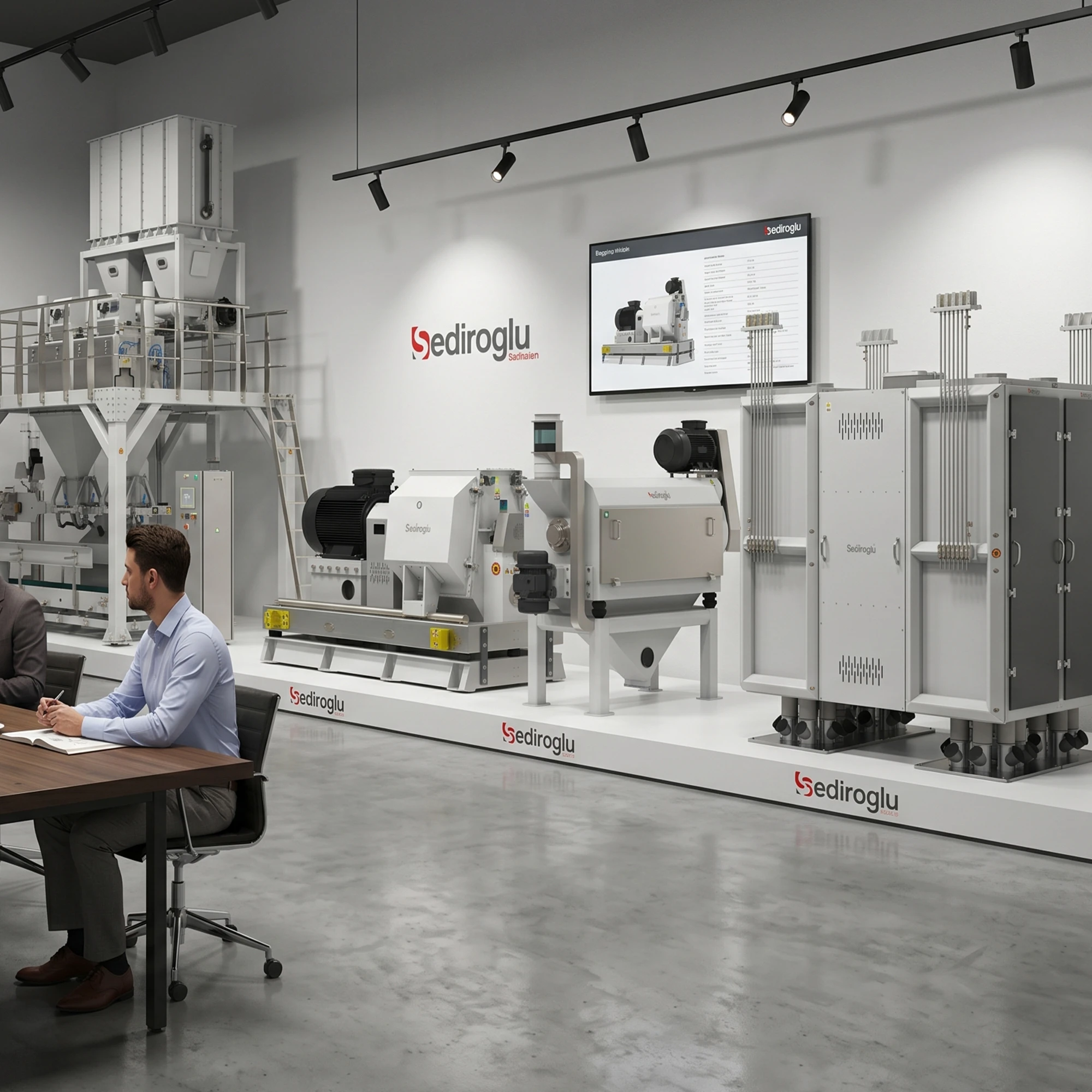
SEDIROGLU GROUP provides machinery and equipment solutions for flour milling and grain-processing applications.
When planning a new wheat mill or upgrading an existing facility, equipment selection should be based on production requirements, raw material characteristics, desired final products and plant layout.
Rather than focusing only on an individual machine, evaluating the complete production flow helps create a more coherent milling system.
Conclusion
Modern wheat flour production depends on a coordinated sequence of cleaning, preparation, grinding, sifting, purification, transport and final product handling.
The right wheat milling equipment is therefore not simply the machine with the largest capacity or most features. It is equipment selected to perform a defined role within a properly designed milling process.
For new flour mill projects, the process flow, required capacity, wheat characteristics, final products and available building space should be considered together. For existing plants, compatibility with current machinery and product routes becomes equally important.
A well-planned milling line connects each processing stage logically—from raw wheat receiving to finished flour handling—creating a system in which machines work together rather than as isolated components.
Frequently Asked Questions About Industrial Flour and Feed Milling Technologies
"At Sediroglu Group, we provide turnkey solutions including flour and feed mill equipment, conveying section equipment, grinding section equipment, and packaging section equipment. We have compiled the most frequently asked questions about our high-efficiency solutions, technical details, and capacity options tailored to your facility. If you have any further questions or require technical consultancy for your project, please contact our expert team."
A complete system may contain grain cleaning machines, conditioning equipment, roller mills, plansifters, purifiers, conveying systems, storage equipment and final flour-handling machinery.
However, it does not operate alone. Industrial flour production also requires cleaning, conditioning, sifting, classification and product transport equipment to create a complete milling process.
A typical industrial line can include wheat receiving equipment, separators, destoners, conditioning systems, roller mills, plansifters, purifiers, product transport systems, storage bins and packaging equipment.
These factors help determine the milling diagram, machine sizes, number of processing stages, product-routing requirements and overall equipment configuration.
Existing flour mills can be upgraded with roller mills, plansifters, purifiers, grain cleaning machines, conveying systems or other wheat milling equipment. Before installation, the existing plant layout, production capacity, available space, machine connections and product flow should be evaluated to determine the most suitable equipment configuration.
Blog Latest Posts
Flour Mill Grinder
Mill Grains | Grain Milling Machines & Processing Solutions